If you’re looking into how to become a paramedic in Queensland (QLD), you’re likely exploring a career that is both challenging and highly rewarding. Paramedics play a critical role in Australia’s healthcare system, providing life-saving care in emergency situations.
In this complete guide, you’ll learn everything you need to know about becoming a paramedic in QLD, including education requirements, study pathways, salary expectations, and alternative career options in pre-hospital care.
To become a paramedic in Queensland, you must complete a Bachelor of Paramedicine and register with AHPRA. Many students choose to start with a Diploma of Emergency Health Care to gain practical experience and enter the workforce sooner while studying.
What Does a Paramedic Do?
Paramedics are frontline healthcare professionals who respond to emergency calls and provide immediate medical care. Their responsibilities include:
- Responding to 000 emergency calls
- Assessing patients and determining treatment
- Performing life-saving procedures
- Using advanced medical equipment
- Transporting patients to hospitals
Paramedics often work in high-pressure environments and must make quick, critical decisions that can save lives.
The Fastest Way to Start in Emergency Healthcare: Diploma Pathway
If your goal is to start working in the emergency healthcare field without spending years at university, the diploma pathway is your best entry point.
A HLT51020 Diploma of Emergency Health Care allows you to:
- Gain practical, job-ready skills in as little as 12–18 months
- Work in real-world emergency and healthcare environments
- Enter the workforce much faster than a university pathway
- Build experience and get a feel for the industy before committing to a full paramedicine degree
This makes it one of the most accessible and flexible pathways into the industry.
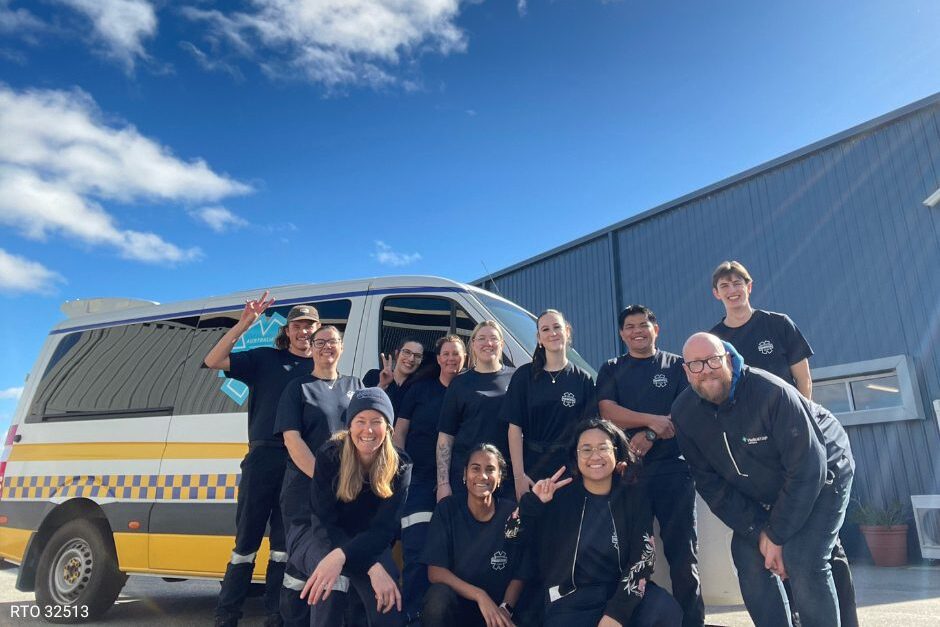
1. Begin with a Diploma of Emergency Health Care (Optional Pathway)
If you’re not ready to go straight to university, the HLT51020 Diploma of Emergency Health Care is a flexible, hands-on way to start. It teaches real-world clinical skills and allows you to work in healthcare while preparing for further study.
2. Complete a Bachelor of Paramedicine
To become a registered paramedic, you must graduate from a Bachelor of Paramedic Science (or equivalent). This course typically takes 3 years full-time and is offered at universities across Queensland and Australia.
3. Register with AHPRA
After completing your degree, you must apply for registration with the Australian Health Practitioner Regulation Agency (AHPRA) under the Paramedicine Board of Australia. Only registered professionals can legally use the title “Paramedic.”
4. Apply for Jobs (QAS or Private)
Most graduates aim to work with the Queensland Ambulance Service (QAS), but there are also opportunities with private medical providers, event medic services, and interstate ambulance organisations.
5. Upskill for Advanced Roles
Once employed, you can pursue higher-level positions such as:
- Advanced Care Paramedic (ACP)
- Intensive Care Paramedic (ICP)
These roles require further study, experience, and internal QAS training programs.
What Jobs Can You Get with a Diploma?
A HLT51020 Diploma of Emergency Health Care can open the door to a range of in-demand roles in pre-hospital care, including:
- First Responder
- Event Medic
- Ambulance Transport Attendant (ATA)
- Patient Transport Officer (PTO)
- Emergency Medical Technician (EMT)
- Medical Emergency Services Officer (MESO/ESO)
These roles are critical to Australia’s healthcare system and often offer:
- Competitive salaries
- Flexible work environments
- Opportunities in regional and remote locations
Many students use these roles to gain experience while deciding whether to pursue full paramedic registration or to work in the industry whilst they study.
Paramedic Requirements in Queensland (QAS Employment Criteria)
To become a qualified paramedic in Queensland, you must meet specific national requirements.
1. Complete a Bachelor of Paramedicine
You must complete an approved Bachelor of Paramedicine or equivalent university degree in Australia. This typically takes three years of full-time study.
2. Register with AHPRA
After graduating, you must register with the Paramedicine Board of Australia through the Australian Health Practitioner Regulation Agency (AHPRA).
3. Gain Employment with an Ambulance Service
Most paramedics in QLD work for Queensland Ambulance Service (QAS). Entry is competitive and based on academic performance, clinical placement experience, and suitability.
Thinking about becoming a Paramedic in Queensland? There are several rewarding career pathways available through the Queensland Ambulance Service (QAS) – whether you’re new to healthcare or already working in the industry.
Roles within QAS include:
- Support Staff
- Patient Transport Officers
- Control Room Staff – Emergency Medical Dispatcher (EMD)
- Paramedic Assistants
- Ambulance Paramedics
- Intensive Care Paramedics
- Advanced Care Paramedics and Managers
As you will discover, Queensland Ambulance Service (QAS) Paramedic positions require a unique set of skills, education and training. In order to provide a high level of paramedic service and quality emergency health care, the Queensland Ambulance Service also offers a guide to the minimum standard of education and training that is acceptable for QLD paramedic jobs.
Guidelines and procedures regulate the paramedic industry across Australia. To be offered an employment contract with Queensland Ambulance Service, applicants must have completed a Bachelor of Paramedic Science degree at an approved university. There is another pathway into university by studying the HLT51020 Diploma of Emergency Health Care for those who missed out on an opportunity to go to university.
Paramedics are now required to be registered with the Paramedicine Board of Australia and the Australian Health Practitioner Regulation Authority (AHPRA). This is to help improve the quality of patient care and make certain the term ‘Paramedic’ and ‘Paramedicine’ can only be used by suitably credentialed and registered persons.
Diploma: A Practical Pathway Before University Paramedicine
Not every student goes straight from school into a university paramedicine degree — and that’s increasingly common. Entry into Bachelor of Paramedicine programs can be competitive, and many school leavers want more time to build confidence, experience, and clarity before committing to university study.
This is where vocational health training can play an important role. Courses such as the HLT51020 Diploma of Emergency Health Care allow students to develop foundational clinical skills and a strong understanding of pre-hospital care before applying to university.
Completing a vocational qualification can help by:
-
providing early exposure to real-world health care and patient care concepts
-
improving academic readiness for university-level study
-
building confidence in clinical decision-making and communication
-
strengthening future university applications through relevant training and experience
For school leavers who didn’t get the ATAR they were hoping for — or who want a more gradual, supported entry into the health sector — this pathway offers a practical and achievable first step.
You can explore these options in more detail on our School Leaver Pathways page.
Paramedic Roles Within Queensland Ambulance Service
-
Ambulance Paramedic
As a QAS Paramedic, you are classed as a registered health professional/practitioner, providing out-of-hospital emergency care and transport for sick and injured people in emergency and non-emergency situations.
Paramedics for the most part work in pairs and collaborate with many other departments within the QAS and additional health care and emergency services providing quality patient care to the Queensland community.
As part of the recruitment process with QAS, applicants may be required to undergo some clinical testing. QAS also recommend applicants have some form of work experience, although this not mandatory; and do state so on the QAS website.
To be eligible for employment with QAS, you also must have the right to work in Australia.
Queensland is a big State and as such, there are 15 Local Ambulance Service Networks (LASNs) across Queensland, ranging from Cape York in the far North to the South West, Darling downs areas, out West and of course the metropolitan areas of SE Queensland. Each of the local ambulance services has a network of ambulance stations which are well-equipped with a wide range of vehicles and specialised equipment.
-
Intensive Care Paramedic (ICP)
Moving up from the job of an Ambulance Paramedic, the Queensland Ambulance Service employs Intensive Care Paramedics (ICP) who are equipped with superior Paramedic training, thus possessing the skills to make difficult and complex clinical decisions without further medical consultation.
Intensive Care Paramedics are highly skilled emergency medical professionals and as such are trained to perform advanced medical procedures that go well beyond that clinical scope of practice of most Paramedics.
Understandably so, there is a high set of standards for those wishing to be an IC paramedic QLD ambulance service employee:
- Complete a Graduate Diploma in Intensive Care Paramedical Practice (or equivalent). This is offset by an Australian Ambulance service jurisdiction in-service qualification.
- Prove your authority to practice as an ICP that is equivalent to the QLD paramedic QAS standards.
- 5 years experience (minimum) as a paramedic in the pre-hospital care/emergency environment.
- At least 2 years as a full-time Intensive Care Paramedic.
- Ability to perform Intensive Care Paramedic procedures.
- Demonstrate skills as a clinical mentor.
- Proof of capacity to support and maintain a high level of clinical governance.
- Demonstrate knowledge and competency with the Drug Therapy Protocols.
- Provide evidence of current/recent experience within this field, commensurate with the role of paramedic QLD employee.
-
Advanced Care Paramedic (ACP)
The role of an Advanced Care Paramedic (APC) within the Queensland Ambulance Service is to provide the highest level of emergency care and be proficient in all forms of paramedical disciplines. They are the critical link between life and death whenever a medical crisis occurs, with extensive experience in pre-hospital care.
Advanced Care Paramedics must also possess a number of non-medical skills and personal qualities, such as superior communication skills, a courageous and compassionate disposition and be calm under pressure – performing their tasks with precision and poise.
These are the minimum standards that the Queensland Ambulance Service requires of all APC applicants:
- A degree in Paramedic Science or equivalent. This is offset by an Australian Ambulance service jurisdiction in-service qualification.
- Prove your authority to practice as an ACP that is equivalent to the QLD paramedic QAS standards.
- 3 years experience (minimum) as a paramedic in the pre-hospital care/emergency environment.
- Ability to perform Advanced Care Paramedic procedures.
- Demonstrate skills as a clinical mentor.
- Demonstrate knowledge and competency with the Drug Therapy Protocols.
- Provide evidence of current/recent experience within this field, commensurate with the role of paramedic QLD employee.
Pathways to Paramedical Careers
There are two distinct pathways into QAS as a Paramedic.
1.Take your time and study a diploma first.
This means you can study in your own time with less interruption to your current lifestyle/family/job. You’ll learn a lot of essential emergency medical skills which on-road Paramedics employ. The diploma is no substitute for the degree; however, it’s the perfect place to begin. Find out more about the HLT51020 Diploma of Emergency Health Care and you can > use the diploma to get into university.
2.Enrol directly into the Bachelor of Paramedic Science degree.
See how many credits you can get towards the degree with the APC HLT51020 Diploma of Emergency Health Care. There are many universities who offer the degree, there’s no shortage of choice.
Links:
* Paramedicine Board
* Australian Health Practitioner Regulation Authority (AHPRA)
* Bachelor of Paramedic Science degree
Frequently Asked Questions
Yes. Diploma-qualified professionals work in roles like mine site medic and event medic. Find out more here.
No, the diploma is a strong starting point. It allows you to begin working in the emergency healthcare field, gain firsthand experience in the industry, and build valuable connections while you progress toward a bachelor’s degree. Some universities also offer credit from your diploma toward the degree, helping you fast-track your studies.
To contact the QAS Recruitment Team, you can email [email protected]
A Diploma of Paramedical Science typically takes around 12 to 18 months to complete, depending on your personal circumstances.
This shorter duration allows you to enter the emergency healthcare field much faster than a traditional university degree, while still gaining the practical skills and experience needed to begin working in entry-level medic roles.